La Porte's history — and its most infamous chapter.
From a 19th-century county seat to the site of one of America's most notorious true crime cases — this is the real, documented history, not embellished local legend.
A 19th-century Indiana county seat.
La Porte was founded in the 1830s and grew into the seat of La Porte County, built around its lakes, farmland, and rail lines connecting Chicago to the rest of the Midwest. The La Porte County Courthouse — the Romanesque Revival building pictured across this site — was completed in the 1890s and still anchors downtown today.
Like much of the Midwest, the area's economy grew around agriculture and small manufacturing, with the county's lakes and farmland later becoming part of what makes it a natural stop for modern travelers passing through the region.

Circa 1907 postcard of an Air Line electric railroad car on Main Street, La Porte. Photo by ChicagoAreaTom, CC BY-SA 4.0, via Wikimedia Commons
The Native American & Pioneer Peace Memorial.
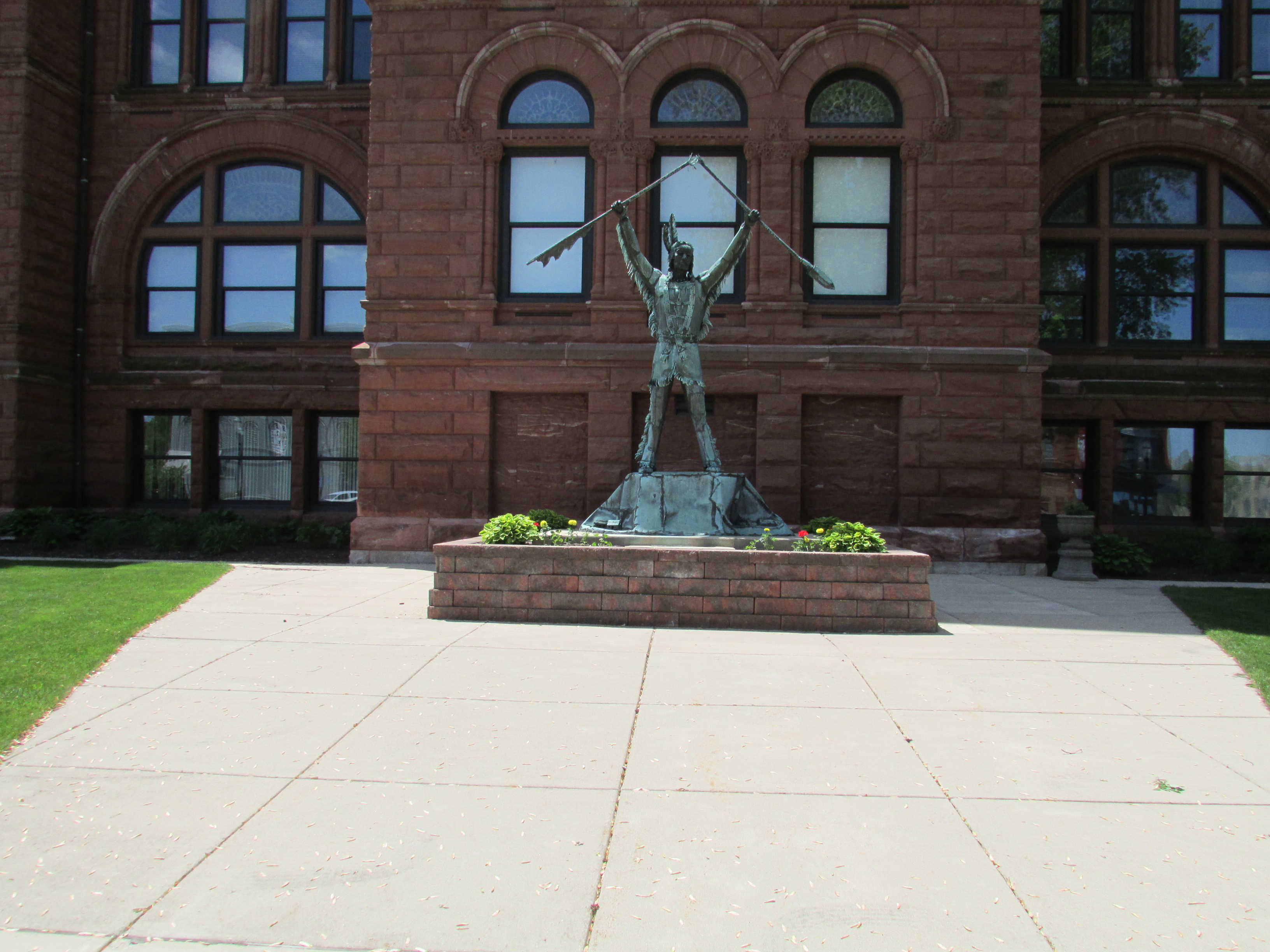
Standing on the courthouse's northeast lawn is a bronze statue of a Potawatomi warrior, sculpted by Howard A. DeMyer. The plaque beneath it reads: "On land once belonging to his people, this Potawatomi Indian stands, his broken spear a symbol of peace with the pioneers."
The Potawatomi are the Native people whose homeland included this part of northern Indiana before removal in the 1830s — the same decade La Porte was founded. The statue stands as a memorial to that history.
Photo by Chris Light, CC BY-SA 4.0, via Wikimedia Commons
Belle Gunness: "Hell's Belle."
This is real, documented history — not folklore. Details below are drawn from historical record, including the La Porte County Historical Society Museum's own exhibit on the case.

Belle Gunness and her children, from a 1908 postcard. Photo by Steve Shook, CC BY 2.0
Belle married twice in the years before the case broke: to Mads Sorenson in 1893, and after his death in 1900, to Peter Gunness in La Porte in 1902. Both marriages ended with Belle collecting on life insurance policies. After Peter's death in 1902, Belle began placing "lonely hearts" ads in Norwegian-language newspapers seeking a husband — several respondents traveled to La Porte with their savings and were never heard from again. The case broke open in April 1908 when Andrew Helgelein's brother, Asa, arrived in La Porte looking for him just as Belle's farmhouse burned down.
Born Brynhild Paulsdatter Størseth
Belle Gunness was born in Selbu, Norway, on November 11, 1859. She emigrated to the United States and eventually settled on a farm just outside La Porte, Indiana.
A "murder farm" uncovered in 1908
In April 1908, a suspicious fire at her La Porte farmhouse led investigators to uncover human remains buried on the property — what newspapers of the era called a "murder farm." At least a dozen bodies were recovered, including Andrew Helgelein and Belle's niece, Jenny Olson.
Questions that remain unanswered
The headless female body found in the ashes was notably smaller than Belle herself, fueling a theory she staged her death and escaped. Farmhand Ray Lamphere was convicted of arson (not murder) and died in prison maintaining Belle was still alive. The full number of victims has never been conclusively established — estimates range from about a dozen to as many as forty.
Still studied today
Gunness is considered one of America's most prolific female serial killers. The case remains part of La Porte's local history, documented and preserved by local historians rather than sensationalized.
Learn more at the La Porte County Historical Society Museum →
Local legend & folklore.
These are stories passed down locally — oral tradition and folklore, not verified claims. We're naming real places with real history, but "haunted" here means legend, not fact. Some details below are disputed even by locals who grew up near these places.
The Gunness farm site
The site of the Gunness "murder farm" is the region's best-known haunted legend, tied directly to the documented 1908 case above — locals have long reported an unsettling feeling at the site.
Kingsbury Ordnance Plant
A massive WWII-era munitions plant, now mostly ruins and state fish & wildlife land. Regularly named among La Porte County's most talked-about haunted sites in local reporting.
Posey Chapel
A popular local ghost story about a chapel fire and a priest's death — though people who grew up in the area dispute key details of the embellished version that circulates online. A good example of how legends grow past the facts.
The doctor's house legend
An oral-tradition story about a 19th-century doctor's family said to have lived along this road — passed down through local ghost-story circles rather than documented record.
Report a sighting.
Tell us what you saw or felt. This is for fun and folklore — not a substitute for reporting anything actually dangerous or illegal, which should go to local authorities.